
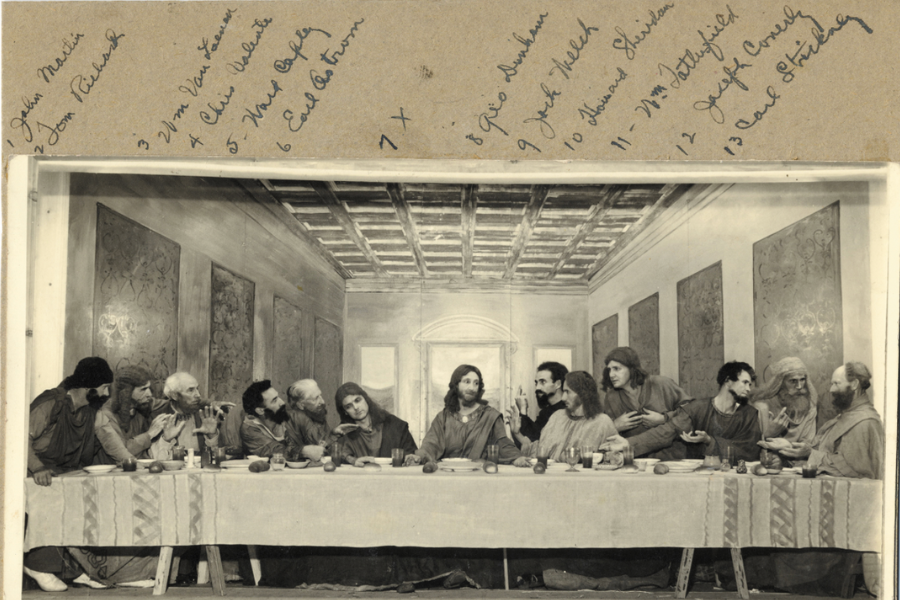
A 1936 photograph of the Pageant’s “The Last Supper.” Cast member No. 7, portraying Jesus, is notably listed without a volunteer name—a mystery rooted in the Pageant’s early history.
For 90 years, Leonardo da Vinci’s The Last Supper has held a special place in the history of the Pageant of the Masters. First presented on the Pageant stage in 1936, the iconic re-creation returns in 2026 to mark its 90th anniversary, continuing a tradition that has made it one of the production’s most recognizable and beloved moments.
“The Last Supper has become such an important part of the Pageant and there is something incredibly special about knowing that audiences were experiencing this same work of art on our stage 90 years ago,” said Pageant of the Masters Director Diane Challis Davy. “While the techniques have evolved over the decades, the heart of what we do remains the same: bringing great works of art to life through the dedication of our volunteers and creating a moment that audiences can experience together. To carry that tradition forward as part of The Greatest of All Time feels especially meaningful.”
The Pageant first presented The Last Supper in 1936, during local artist Roy Ropp’s second year as director. Ropp selected Leonardo’s masterpiece as the finale of that summer’s production, an ambitious undertaking that required designing and building a significantly larger stage than the year before. His wife, Marie Ropp, arranged live music and narration and worked alongside friends and neighbors on other production elements. The presentation combined the living tableau with narration and a performance of “The Lord’s Prayer,” helping establish a finale that would become closely associated with the Pageant for generations.
As the Pageant grew in popularity, the production moved to larger venues to accommodate increasing audiences and began attracting national attention. By 1941, Ropp received approval to build a stage house and bowl at the Pageant’s present location, establishing a permanent home for the growing Laguna Beach summer tradition.
The original 1936 presentation also holds a surprising piece of Pageant history. When Ropp cast the central figure of Jesus, a Festival board member ultimately accepted the role on the condition that her identity remain private. “The Pageant’s original portrayal of Jesus was performed by a woman,” confirmed Challis Davy. A different identity was publicly circulated at the time to preserve her anonymity, and she continued in the role until the Festival suspended operations during World War II.
When the Pageant returned in 1946, The Last Supper returned with it. Although it was occasionally omitted in later years when it did not fit the theme of a particular production, Leonardo’s masterpiece became—and remains—the Pageant’s traditional finale. As the production grew to require two casts, two dedicated Last Supper casts began alternating performances, continuing a tradition carried forward by generations of Pageant volunteers.
The Pageant’s re-creation has also evolved to reflect new discoveries about Leonardo’s original fresco. A 20-year restoration completed in 1999 revealed details and colors that had been obscured over centuries. Following the restoration, the Pageant updated its own presentation to more closely reflect the newly revealed details of the masterpiece.
Today, the same elements that have defined the Pageant for generations: lighting, makeup, music, theatrical illusion and remarkable stillness, continue to bring Leonardo’s masterpiece to life. Ninety years after Roy and Marie Ropp first introduced The Last Supper to the Pageant stage, the tableau remains one of the production’s most recognizable traditions and a lasting connection between the Pageant’s past and present.
Audiences can experience the 90th anniversary of The Last Supper as part of the 2026 Pageant of the Masters, The Greatest of All Time, running nightly through September 4, 2026. This year’s production celebrates the artists and works that have left an indelible mark on art history, bringing masterpieces by Michelangelo, Picasso, Monet, Van Gogh, Kahlo, Rockwell and more to life through the Pageant’s signature blend of art, theater and illusion.
For more information and to stay up to date on all things Pageant of the Masters and Festival of Arts, follow the Festival on social media at @FestivalPageant and visit www.foapom.com.